By Karolina Pajdak
Vienna – What’s the latest on climate change? How can we tell the story of climate change in a way that resonates with people, and how is climate change actually changing our everyday lives?
Over three days, journalists from Germany, Portugal, Iceland, Ireland and Austria drew inspiration at the 2nd Learning, Teaching and Training Activity (LTTA) organised by ‘Media for Future’ in Vienna.
The Austrian project partner, the Forum for Journalism and Media Vienna (FJUM), had organised and arranged excellent guided tours, lectures and interview opportunities at venues including the Institute of Science and Technology Austria (ISTA) in Klosterneuburg, the Smart City Seestadt and the International Institute for Applied Systems Analysis (IIASA) at Laxenburg Castle.
Science, Storytelling and the City of the Future
A key question of the event – and a central question of the ‘Media for Future’ project – was: How can we give climate issues more space in news coverage? Why are they so often absent from the media?
Austrian journalist Nadja Hahn and Irish journalists Shauna Corr and Colman O’Sullivan discussed this. One thing became clear: we need more practical journalistic formats that link climate change more closely to people’s everyday lives – both within and outside traditional editorial structures. For example, after leaving public service broadcasting in Austria, Nadja Hahn launched her own podcast (‘Full Circle’).
Glaciers, clouds and more
The journalists met knowledgeable and inspiring interviewees on climate issues. Together with Prof. Francesca Pellicciotti, Professor of Glacier Research, they explored the question of how climate change is altering the Earth’s glaciers and water resources at the Institute of Science and Technology Austria (ISTA) in Klosterneuburg near Vienna. The Swiss researcher has been leading the ‘Cryosphere and Mountain Hydrosphere’ research group there since 2023.

Very interesting: whilst glaciers around the world are melting as a result of global warming, there is one region on Earth where they are growing steadily – the Karakoram and Pamir mountain ranges in Central Asia. This phenomenon is of particular interest to climate researchers because it shows how differently glaciers can react to changing climatic conditions.
Clouds are also a key focus at ISTA. This is because clouds are among the greatest sources of uncertainty when predicting climate change. They can cool the Earth by reflecting sunlight back into space. At the same time, they can contribute to warming by trapping thermal radiation. The strength of these effects depends, amongst other things, on the altitude at which clouds form, how dense they are and how they are spatially distributed.
This is precisely where Prof. Caroline Muller’s research comes in. At ISTA, the French climate scientist is investigating how clouds form, why they coalesce into large cloud fields and storm systems, and how these processes influence the global climate.
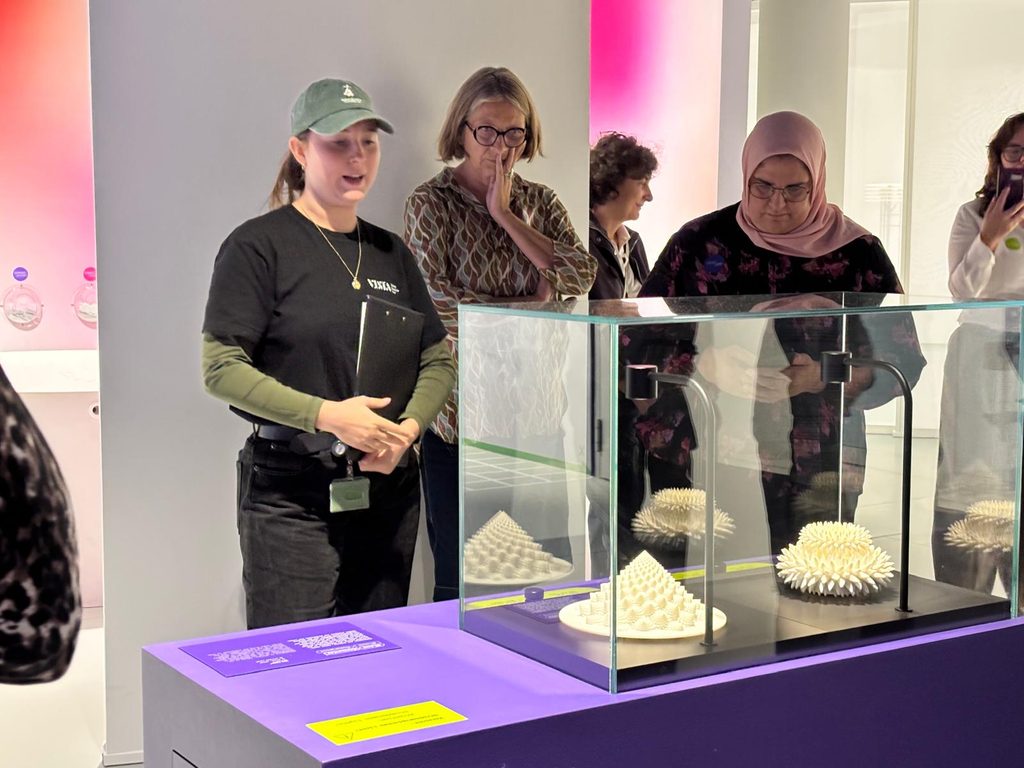
Climate science is explained in an engaging way at the VISTA Science Experience Centre.
Daniel Huppmann is conducting research at the International Institute for Applied Systems Analysis (IIASA) in Laxenburg into a key question in climate policy: How can we use mathematical models to calculate which measures are necessary to limit climate change – and what economic and social consequences these measures will have? His research lies at the intersection of mathematics, energy systems, economics and climate policy.
There are plenty of topics and knowledgeable people to talk to – as became abundantly clear over the three days – when it comes to analysing and discussing climate change. You just have to want to …