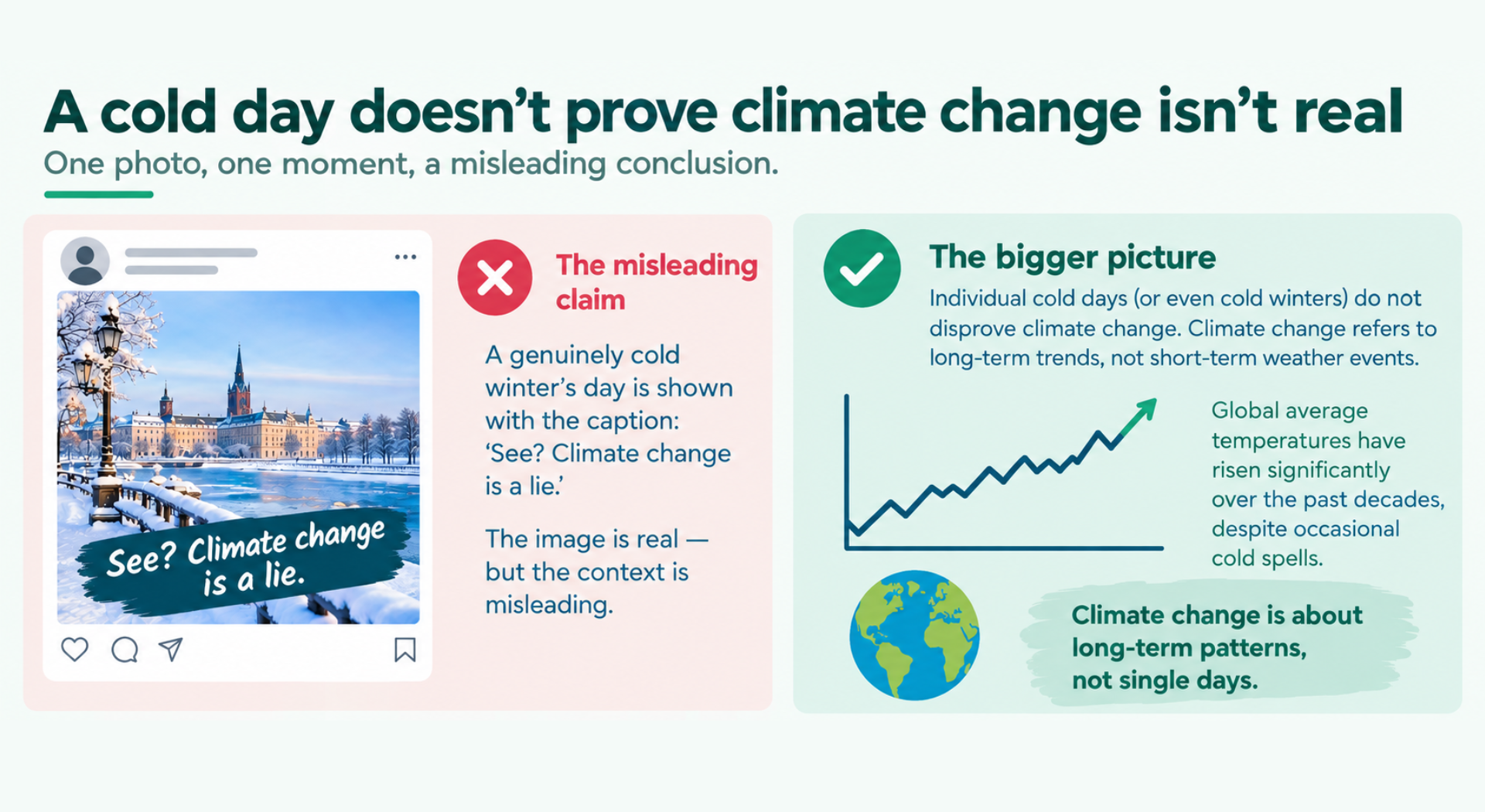
Image source: AI-generated
The first step when debunking fake news in regard to climate change is to develop a basic understanding of climate change (see Module 1 for details, where participants will familiarise themselves with key scientific concepts, such as the greenhouse effect, the causes of global warming and the role of human activities). This foundational understanding is essential for being able to identify false or misleading claims in the first place. Building on this, participants learn to recognise typical characteristics of fake news, as for instance a selective use of data, misleading graphics, false causal links, or the quoting of so-called ‘experts’ without a scientific reputation. Other relevant factors are emotional manipulation and oversimplified narratives. Furthermore, we will be focussing on media and information literacy. Participants will practise verifying sources, by asking the following questions:
- Who is providing the information?
- Who is communicating the information?
- What interests might be at play?
- What reliable alternative sources are available, and how can the information be independently verified?
- Are scientific studies referenced correctly?
Specific tools and strategies are also taught, such as fact-checking, reverse image search or evaluating studies (peer review, research consensus). The course will also teach participants about how disinformation is deliberately spread. This includes insights into social media, algorithms, echo chambers and the role of political or economic actors in spreading climate scepticism. A key part of the course is practical application: participants will analyse real-life examples of articles, reports or social media posts on climate change and identify problematic content within them. Through group work or discussions, they can compare and reflect on their assessments. Finally, the course also focuses on communication: how can one respond to fake news in a factual and convincing manner without escalating conflicts? Here, participants learn to convey evidence-based arguments clearly and to address typical counter-arguments. The combination of online modules (e.g. videos, quizzes, self-tests) and synchronous formats (discussions, workshops) promotes both individual learning and collaborative exchange.
AI disclaimer
Artificial intelligence (AI) was used in the creation of this module to generate images.
Course completion and certificate
To receive a certificate of completion, please make sure to click “Mark as complete” at the bottom of every sub-chapter after you have completed it. The certificate can only be issued once all sub-chapters have been marked as complete.