
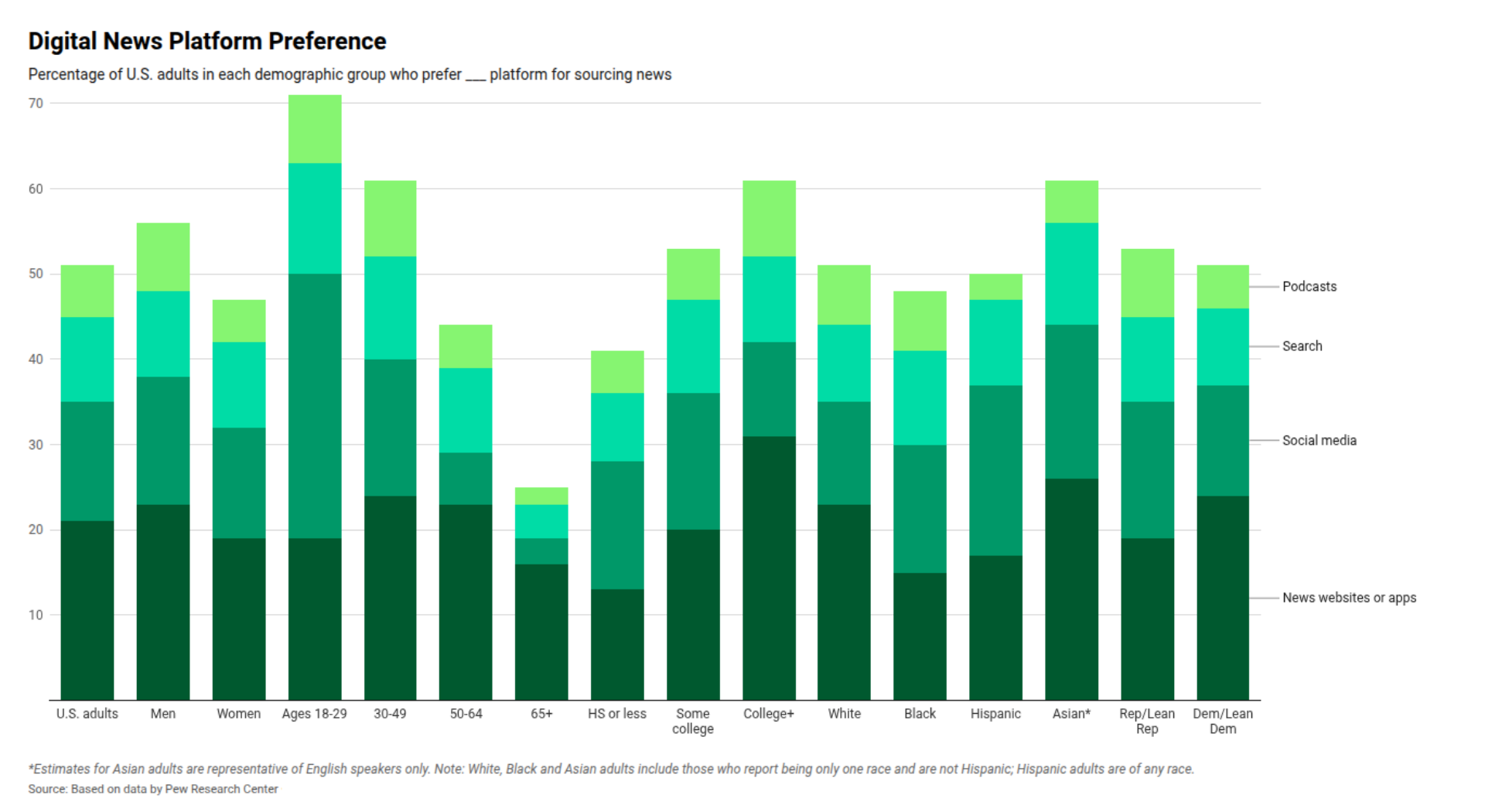
Each group is formed by a variety of demographics that differ in age, gender, race, ethnicity and lived experience.
More traditional paper, radio or television formats will not appeal to all of these groups. According to a 2025 Pew Research study, 86% of U.S. adults say that they sometimes get news from a smartphone, computer or tablet, and 56% say that they often get news from these sources. Audiences are gathering their news from search engines, social media, apps, podcasts, email newsletters and even AI chatbots.
To reach the widest audience, cross-channel news distribution has become essential. This means publishing the same content across all platforms, while taking care to tailor the presentation of content to each. For example, rather than posting a photo of a published print article to Instagram, newsrooms should use engaging short-form videos.
Pew Research Center’s data reinforces the importance of cross-channel news distribution. It tells us that Americans in the 50+ age range are more likely to get their news from TV and print, while younger generations generally prefer social media and podcasts. The audience’s level of education is another considerable factor– Americans with a college degree are more likely to source their news from websites, apps, podcasts and newsletters. Those without a college degree tend to prefer getting their news via social media. The Reuters Institute’s 2025 Digital News Report also notes that the consumption of news through social videos is trending upward in all markets.
However, this doesn’t mean that all news coverage should be shrunken down and packaged into short-form videos. The media format (whether that is a news brief, an explainer, a podcast, a feature or any other type of storytelling) needs to fit the platform. See the Media Formats in Climate Journalism module for more information.