
Image source: AI-generated
Addressing climate change requires more than setting targets or adopting environmental policies. It involves decisions about who acts, who sets the rules, who provides resources, how information is shared, and how progress is assessed and challenged. Climate governance refers to the structures, processes and relationships through which these decisions are made and translated into action.
Traditionally, climate governance was understood primarily as a domain of states and international institutions. Governments remain central actors, establishing policies, regulations and climate targets, while international agreements provide the architecture for collective action. However, contemporary climate governance is increasingly understood as a broader ecosystem, in which corporations, investors, civil society, citizens and the media interact with public institutions and influence both decisions and outcomes.
Corporations have become particularly important actors. Their decisions affect emissions, technologies, supply chains, investment and patterns of production and consumption. Corporate climate commitments, including transition plans and net-zero targets, have consequently become part of wider decarbonisation strategies. In Europe, this role is reinforced by the European Green Deal and related regulation, which place businesses within a broader transition towards a climate-neutral economy.
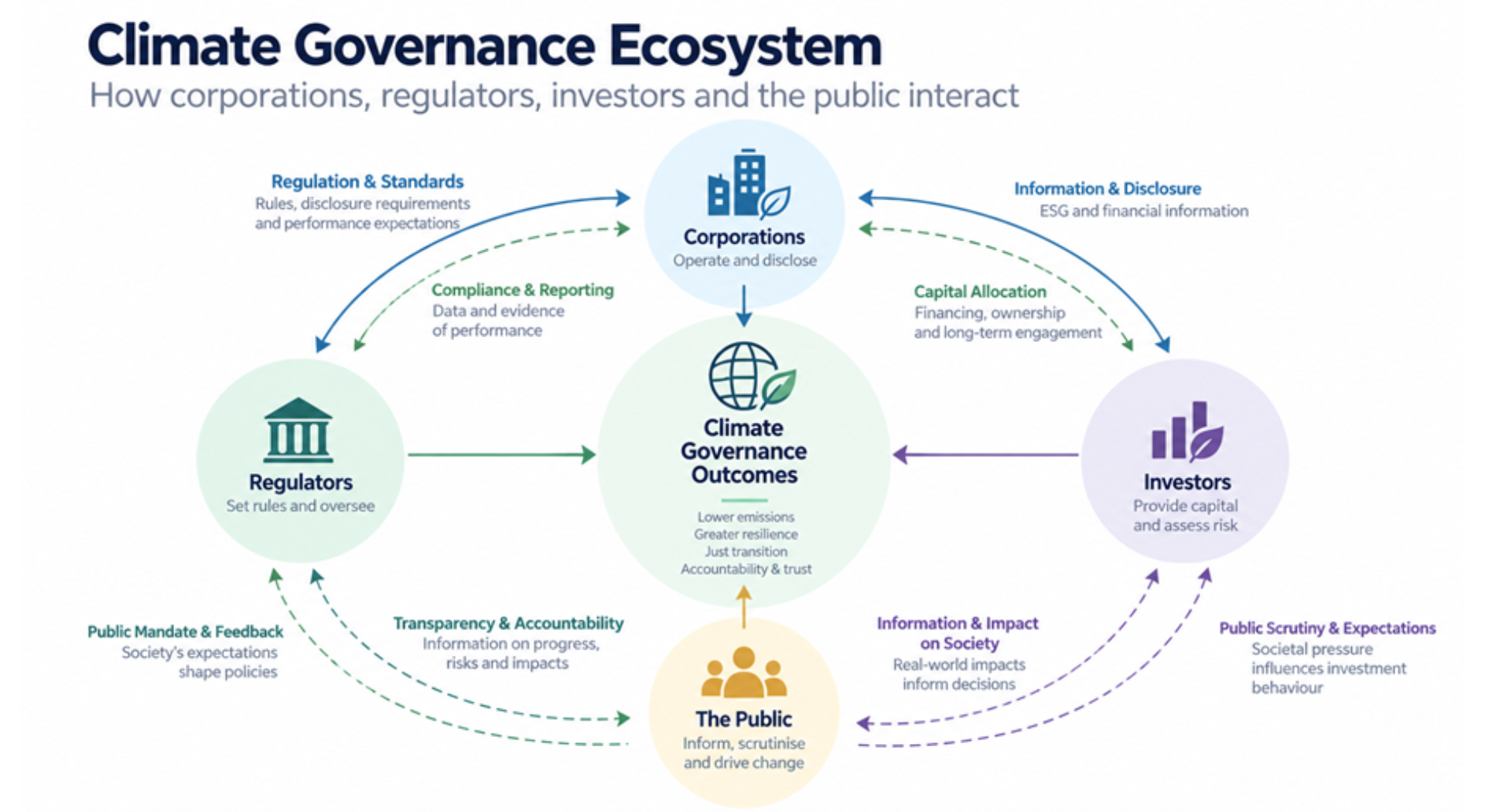
But corporations do not act independently. Regulators establish the rules and disclosure requirements; companies generate information and implement actions; investors use information to assess risks and allocate capital; and citizens, civil society and the media create scrutiny, expectations and pressure for accountability. These relationships operate in both directions: corporate behaviour can influence regulation, public expectations can affect investment decisions, and disclosed information can shape both market and societal responses. As such it is important to bear in mind four interconnected roles:
- Regulators (regulation and oversight): establish climate policies, standards and disclosure requirements, monitor compliance and create incentives for change.
- Corporations (action and disclosure): manage climate impacts and risks, establish targets and transition plans, adapt operations and value chains, and report performance.
- Investors (capital and influence): assess climate-related risks and opportunities, allocate capital and use ownership and engagement to influence corporate decisions.
- The public (scrutiny and accountability): citizens, communities, NGOs and the media question claims, demand transparency and influence both policy and market behaviour.
The effectiveness of climate governance therefore depends not simply on the actions of individual organisations, but on the quality of the relationships, information flows and accountability mechanisms between these actors. Regulation affects corporate behaviour; corporate disclosure informs investors and the public; investment decisions influence business strategy; and public scrutiny can reshape both political and corporate priorities.
For climate journalism, this ecosystem perspective is particularly important. A corporate climate claim rarely exists in isolation. It can be examined against regulatory requirements, reported performance, investment decisions, stakeholder impacts and public commitments. Journalism therefore forms part of the governance ecosystem itself: by connecting information across actors, testing claims against evidence and making inconsistencies visible, it can strengthen transparency and accountability.