
Image source: AI-generated
The transition to a low-carbon and climate-resilient economy involves much more than reducing greenhouse gas emissions or replacing one technology with another. It can transform industries, jobs, skills, investment, communities and patterns of production and consumption. These changes create opportunities, but they can also generate costs and disruption. The concept of a just transition addresses a fundamental question: how can societies achieve necessary climate goals while ensuring that the process of change is fair and inclusive?
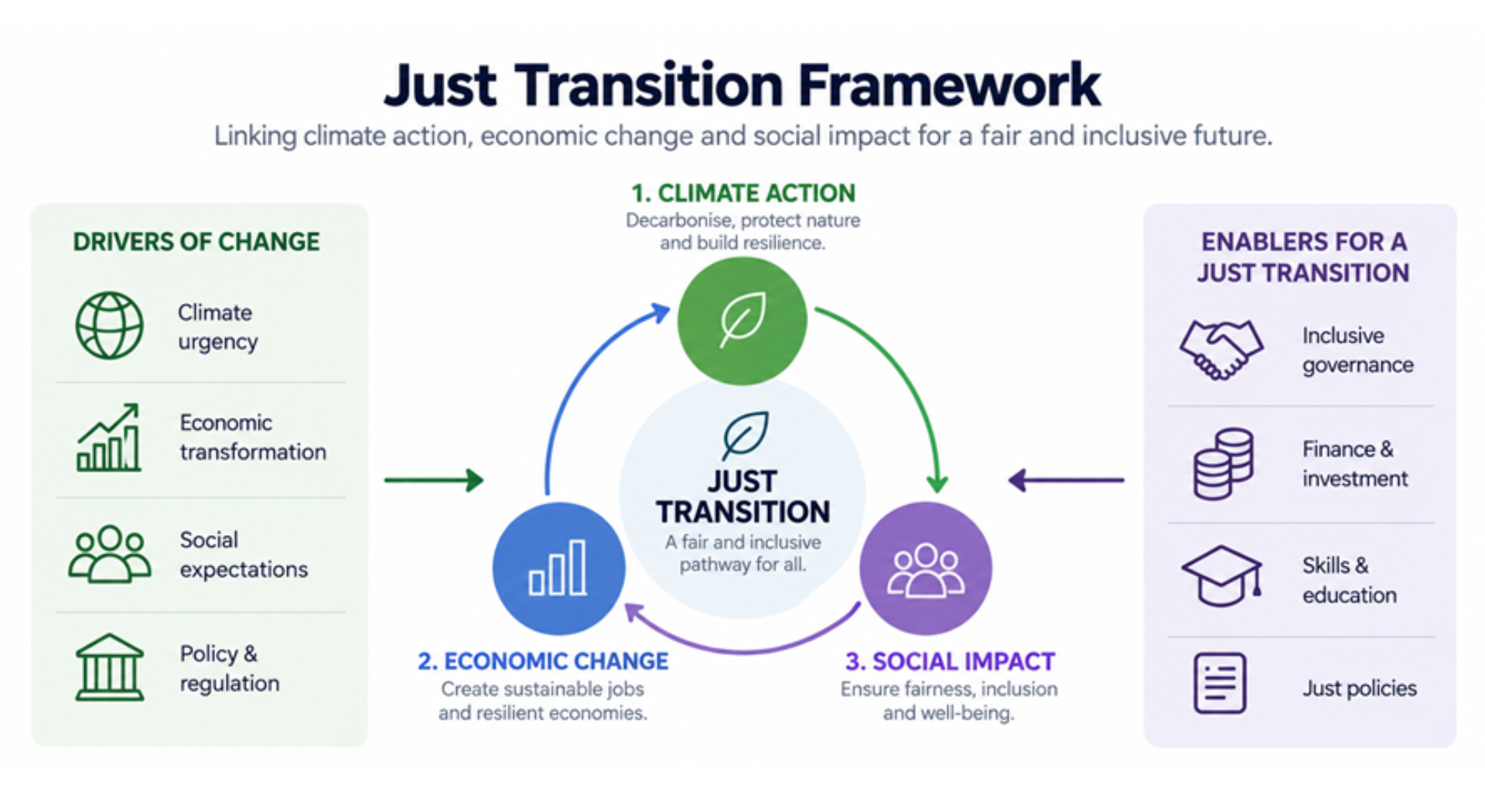
A just transition therefore connects three dimensions that cannot be considered separately: climate action, economic change and social impact. Climate policies can accelerate decarbonisation and innovation while simultaneously affecting employment, household costs, regional economies and access to essential services. The challenge is not to choose between environmental and social objectives, but to design transition pathways that advance both.
Moving towards renewable energy, cleaner mobility, low-carbon industries and more sustainable production can stimulate innovation, investment and new employment. At the same time, existing jobs and business models may disappear or change substantially. Workers may need new skills, companies may face significant adaptation costs, and regions that depend on carbon-intensive industries may experience concentrated economic and social impacts.
The effects are also not distributed equally. Higher energy or transport costs, for example, can affect lower-income households disproportionately. The closure of a carbon-intensive facility may contribute to national emissions targets while having profound consequences for the community in which it operates. Renewable energy and other green infrastructure can provide major environmental benefits while also raising questions about land use, local communities, access to resources and the distribution of benefits.
What makes a transition “just”?
A just transition is not simply a transition accompanied by social measures. It requires fairness to be incorporated into how climate and economic decisions are designed and implemented.
Several elements are particularly important:
- Inclusive governance: workers, communities, businesses and civil society should have meaningful opportunities to participate in decisions that affect them.
- Skills and education: workers need opportunities to develop the capabilities required by changing industries and emerging occupations.
- Finance and investment: capital should support sustainable economic transformation while also addressing the needs of sectors, regions and communities facing significant adjustment.
- Social protection and fair policies: transition measures should anticipate unequal impacts and provide appropriate support, particularly for vulnerable groups.
- Decent work and economic opportunity: creating green jobs is important, but their quality, accessibility and location matter as well.
Assessing a transition only through emissions reductions can therefore provide an incomplete picture. A policy or investment may perform well environmentally while producing significant economic or social costs. Conversely, resistance to climate measures may sometimes reflect not opposition to climate action itself, but concerns about who is expected to bear those costs and whether credible alternatives exist.
A just transition perspective asks us to examine both the outcome and the process: who benefits, who bears the costs, who participates in decisions, whose interests are represented, and whether affected people have realistic opportunities to adapt.
This opens an important dimension of climate reporting. Climate stories are not only about technologies, emissions and targets; they are also about people, employment, places, resources and power. Reporting on a factory closure, a renewable energy development, carbon pricing, electric mobility or changes in agriculture can therefore examine both environmental benefits and their economic and social consequences.
It also helps avoid an overly simple distinction between being “for” or “against” climate action. Conflicts surrounding transition policies may reveal legitimate questions about distribution, participation, rights and fairness that are themselves part of the climate story.
The transition is shaped by both drivers of change and enablers for a just transition. Climate urgency creates the environmental imperative for action, while economic transformation, social expectations, and policy & regulation increase pressure on organisations and societies to adapt. These drivers, however, do not determine whether the transition will be just. That depends on the conditions under which change is implemented. Inclusive governance, finance & investment, skills & education, and just policies act as key enablers, helping societies manage the interaction between climate action, economic change and social impact. A just transition therefore depends not only on the pace and direction of change, but also on the institutional and social capacity to manage that change fairly.