
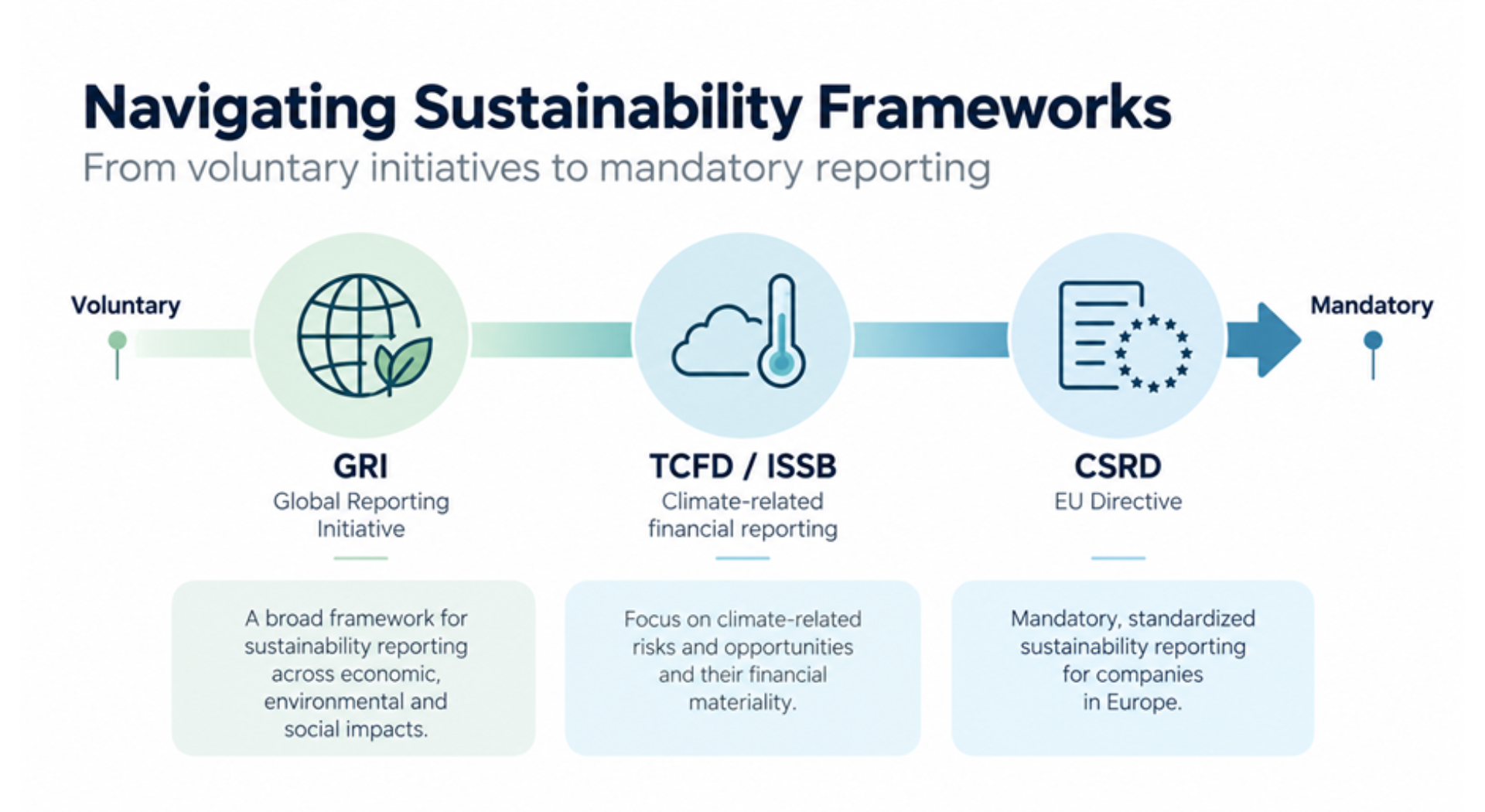
Image source: AI-generated
Environmental, Social and Governance (ESG) has become an important lens through which environmental, social and governance factors are incorporated into the assessment of organisations, particularly in relation to risk, performance and investment decisions. It has contributed to bringing sustainability information into corporate reporting and financial analysis and to increasing demand for measurable and comparable information.
ESG commonly addresses three broad areas:
- Environmental (E): greenhouse gas emissions, energy use, pollution, resource use and biodiversity.
- Social (S): labour practices, human rights, diversity, health and safety, and supply-chain conditions.
- Governance (G): corporate oversight, executive remuneration, risk management, business ethics and transparency.
At the same time, ESG should be clearly distinguished from sustainability reporting itself. The sustainability reporting landscape has evolved from predominantly voluntary disclosure towards more structured and, particularly in Europe, mandatory reporting. Frameworks, standards and regulatory requirements such as GRI, the TCFD recommendations, ISSB standards and the EU’s CSRD reflect different stages and perspectives within this evolution. Together, they illustrate the growing expectation that companies provide systematic evidence about their sustainability impacts, risks, opportunities and performance.
This evolution is intended to support greater consistency, comparability and accountability. However, more disclosure does not necessarily mean better or more trustworthy information. ESG indicators and ratings are not fully standardised, and different providers may assess the same company differently because they use different methodologies, weighting systems, reporting boundaries and data sources. Corporate sustainability reporting may also contain data gaps, rely on estimates or company-reported information, and allow organisations to place greater emphasis on favourable aspects of their performance.
Is is important to highlight three key aspects when developing communication in this context:
- Comparability issues: ESG ratings, scores and indicators may be based on different definitions, methodologies, scopes and weighting systems. Apparently similar measures may therefore not be directly comparable.
- Data gaps and quality: sustainability assessments can depend on company-reported data, estimates and incomplete datasets. Differences in reporting boundaries and methodologies can significantly affect results.
- Narrative flexibility: reporting involves choices about what to measure, emphasise and contextualise. Positive developments may receive considerable attention while negative trends, trade-offs or less favourable indicators receive less visibility.
For journalism and analysis, understanding ESG and sustainability reporting therefore means not only interpreting the data, but also questioning how that data is constructed. A reported indicator should be examined in terms of its source, definition, scope, methodology and level of verification. Sustainability reports can provide valuable evidence on emissions, climate risks, environmental impacts, targets, transition plans and corporate performance — but that evidence needs to be interpreted critically and placed in context.
For climate journalism, this creates both a valuable source of information and an important object of scrutiny. The task is not simply to communicate what organisations report, but to examine whether the evidence supports their claims, whether performance is changing over time, and what may be missing from the reported picture.