
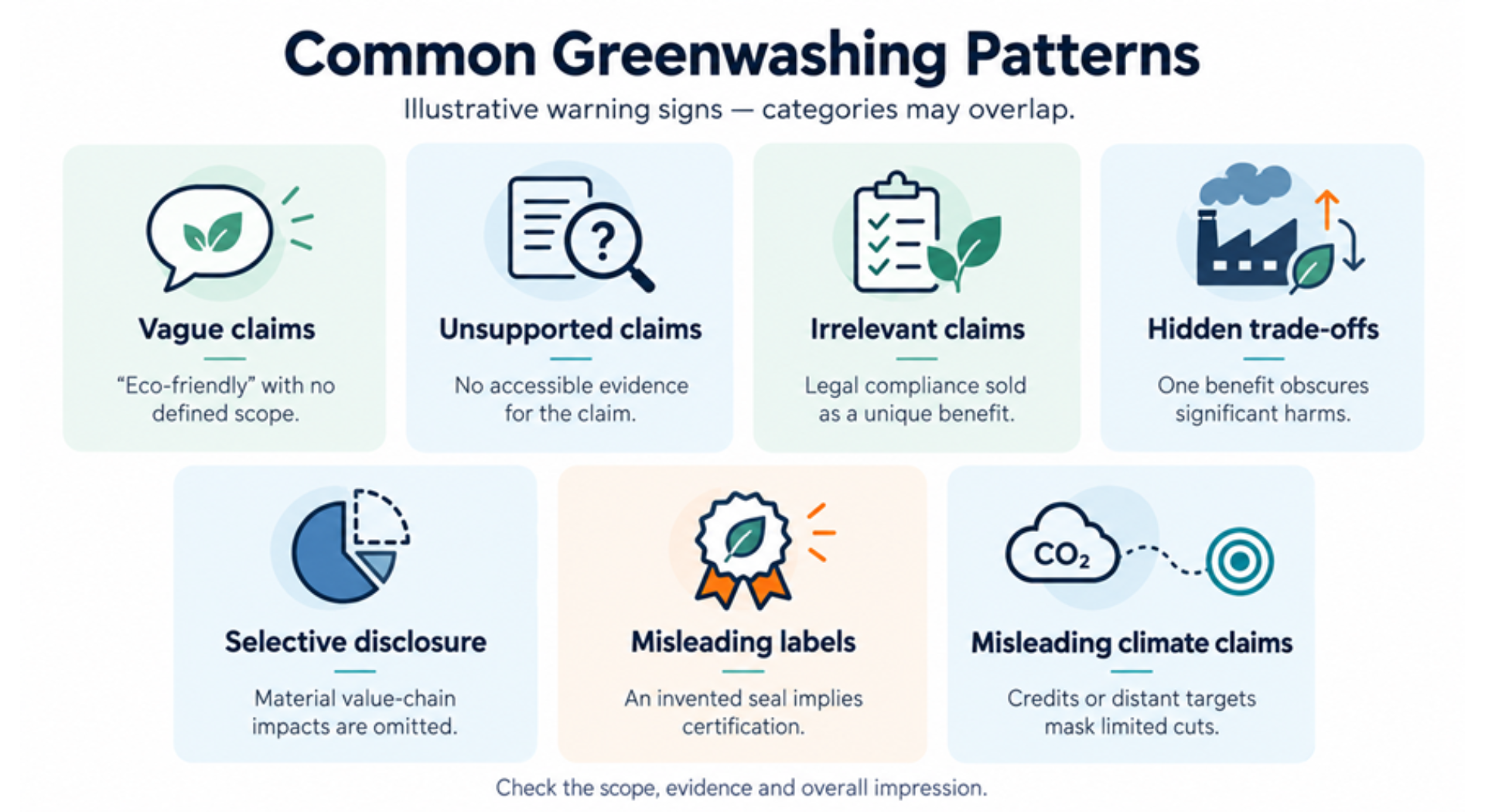
Image source: AI-generated
1. What Is Greenwashing? Concept and Definition
Greenwashing occurs when environmental communication gives a product, service, project or organisation a more favourable environmental image than the evidence supports. It can appear in advertising, packaging, sustainability reports, press releases, investor presentations and climate commitments. The problem is not limited to statements that are demonstrably false. A claim may be technically accurate yet still mislead because it is vague, exaggerates a small improvement, leaves out significant impacts or implies that a benefit applies more widely than it does. The overall impression matters as well as the accuracy of each individual statement.
For example, a company may accurately state that a product contains recycled material. If it uses that single fact to describe the entire product as environmentally friendly, readers also need to consider its production, use and disposal. Similarly, a reduction in emissions at the company’s own facilities may be genuine, but a claim about the company’s overall climate performance requires an appropriate reporting boundary and an account of other material emissions. In both cases, the question is whether the evidence supports the scope of the claim.
Greenwashing may be deliberate, but a misleading impression can also result from poor measurement, ambiguous language or incomplete communication. Nor does poor environmental performance, on its own, prove greenwashing: a company that reports its impacts candidly may have substantial work to do without misrepresenting its position. For journalists, the task is to identify exactly what is being claimed, determine what a reasonable reader would understand from it, and test that impression against the available evidence.
2. Common Types of Greenwashing
There is no single exhaustive classification of greenwashing. An influential earlier framework, the Seven Sins of Greenwashing, was developed largely around environmental claims on consumer products. The following seven patterns adapt that approach to contemporary product claims, corporate reporting and climate commitments. They can overlap: one statement may be vague, selective and unsupported at the same time.
- Vague or exaggerated claims. Words such as “green”, “eco-friendly” or “sustainable” can suggest a broad environmental benefit without explaining what has improved. Absolute expressions such as “100% environmentally friendly” demand particular scrutiny. A useful claim specifies the product or activity concerned, the environmental attribute, its limits and the basis for comparison. “Packaging contains 50% recycled plastic”, for example, makes a narrower and more testable statement than “an eco-friendly product”.
- Unsupported or false claims. An assertion such as “emissions fell by 30%” needs an identifiable baseline, reporting period, boundary and calculation method. If the evidence is inaccessible or inadequate, readers cannot verify the assertion; that does not, by itself, establish that it is false. A fabricated figure or invented test result is a different, more direct form of misrepresentation. Independent certification may help substantiate a claim, but it is not the only possible form of credible evidence.
- Irrelevant claims. A business may present an ordinary feature or a legal obligation as if it were a distinctive environmental achievement. A statement can be factually true yet give the misleading impression that the product is preferable to alternatives that meet the same requirement. The relevant question is whether the advertised feature represents a meaningful advantage, beyond what comparable products already provide or the law already requires.
- Hidden trade-offs. This pattern emphasises one positive attribute while giving insufficient attention to other significant impacts. Recycled packaging, for instance, may be a real improvement without justifying a claim that the whole product is sustainable. The concern is the broader impression created by promoting one feature, particularly when production, transport, use or disposal may account for important environmental effects.
- Selective disclosure. In a corporate report, a company may prominently present favourable indicators while omitting or obscuring information needed to assess its overall performance. For example, it might highlight reductions in direct emissions while leaving out material emissions in its value chain, without clearly explaining the reporting boundary. This differs from a hidden trade-off chiefly in scale: it concerns the selection and presentation of information across a report or corporate claim. An omission warrants investigation; its significance depends on what was excluded and why.
- Misleading labels and endorsements. A logo, seal or certificate can imply independent approval when none exists, or suggest that an entire product has been assessed when certification covers only one attribute. Readers should check who issued the label, which criteria were used, what was examined and whether the endorsement is current. A company-created label is not automatically deceptive, but it should not be presented in a way that falsely suggests independent certification.
- Misleading climate claims. Claims such as “carbon neutral” or “net zero” can obscure the difference between reducing a company’s own emissions and purchasing carbon credits. A distant target can likewise create an impression of progress without interim milestones or an implementation plan. Carbon credits and long-term targets are not inherently evidence of greenwashing; the concern arises when they are used to mask continuing emissions, are presented as direct reductions, or lack a credible explanation of their role. The UN’s guidance on credible net-zero commitments distinguishes carbon credits from the emissions reductions required of an organisation.
These patterns are prompts for investigation, not automatic verdicts. Assessing a claim requires its full context: what it covers, what it leaves out, the quality of its supporting evidence and the overall impression it creates.